OPPD is public power. Public input is part of what happens next. Learn what’s in the plan, what’s changing, and how to get involved.
What is the Integrated System Plan (ISP)?
The ISP brings together big decisions about OPPD's future power system. Open each topic to see the decision, considerations, and impact.
The decision
OPPD is modeling different growth scenarios, including how quickly
large new customers may increase the amount of electricity they need.
Demand projections play a huge role in determining how much new power
generation to build, because the Southwest Power Pool’s resource
requirements are based on the utility’s actual peak load.
The considerations
Build too little and the system may not have enough capacity when
demand rises. Build too much, too soon, and customers can end up
paying for resources that may not be needed.
The impact
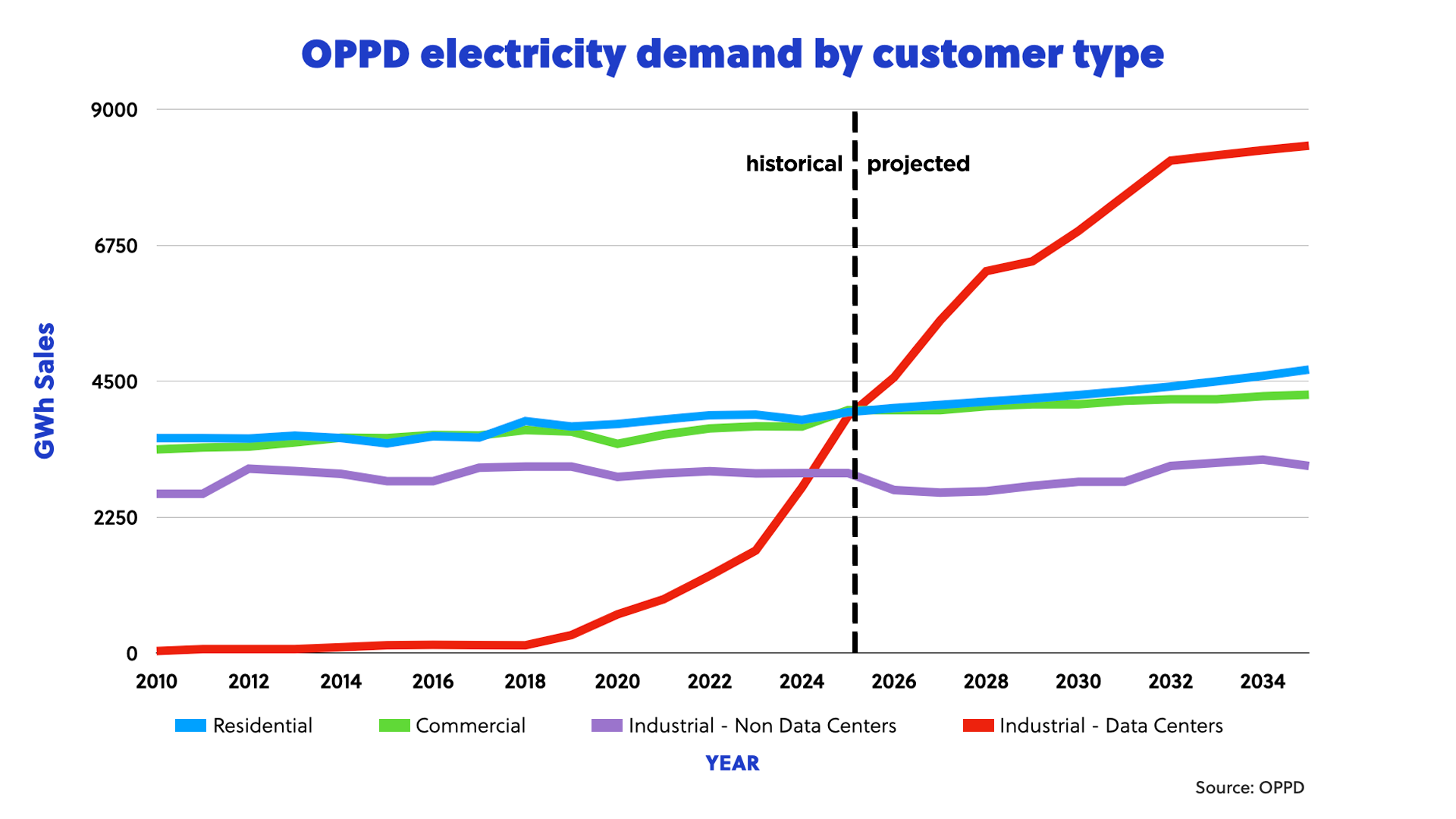
OPPD says its power needs are growing much faster than they were a few years ago — 2,400% more annually. Large new customers, primarily
data centers, are a major part of that increase. According to OPPD
figures reported by Nebraska Public Media, data centers used 1% of
electricity sold by the utility back in 2018. As of 2024, data
centers used 21% of the electricity sold and are expected to account
for 41% of sales by 2035.
The decision
The ISP is comparing different mixes of resources, including
generation from fossil fuels like coal and gas, renewable energy,
storage, and options that reduce or shift customer demand.
The considerations
Different resources come with different costs, construction timelines,
fuel needs, operating characteristics and environmental impacts.
The impact
These choices will shape OPPD’s energy mix for years and are directly connected to what happens at North Omaha Coal Station and what new resources are built elsewhere.
The decision
OPPD compares the cost of different resource options, including fuel,
purchased power, transmission and other system needs.
The considerations
Different choices create costs at different times. Building something
new can require a large upfront investment, while keeping older
resources can carry ongoing fuel, maintenance, and other costs.
The impact
These choices affect OPPD’s finances and customer rates, especially
during a period of major investment and rising system costs.
The decision
OPPD’s board committed to reaching net-zero carbon emissions by 2050.
The ISP will determine what needs to change for OPPD to stay on a path
toward that net-zero goal.
The considerations
Shortly after the OPPD Board set its net zero by 2050 target, OPPD
published “Pathways to Decarbonization”, a report done in partnership
with the consulting firm E3, which found that “OPPD can achieve net
zero carbon while balancing affordability and reliability.” OPPD says
replacing or reducing fossil generation requires significant
investment in new generation, transmission, storage, and other system
resources. Delaying those investments keeps existing fossil plants
operating longer and extends the carbon pollution that comes with them.
The impact
If OPPD falls behind, coal and gas stay in the system longer and more
carbon pollution continues. Every delay leaves less time to meet the
board’s own 2050 commitment.
What does Omaha need to power the next decade?
OPPD uses computer modeling to test different ways the region could meet future electricity needs. OPPD feeds the model assumptions about population growth, large new customers, weather, existing power plants, costs, transmission limits and reliability rules. The model then tests different combinations of resources to see what could meet the projected need. These results help show which options OPPD may consider as it plans for the next decade.
Demand is growing fast.
OPPD says demand is rising quickly, and data centers are the largest industrial customer group driving that increase. That growth is one reason OPPD is planning for more generation and transmission in the years ahead.
21% → 41%
Data centers’ share of OPPD electricity sales, 2024 to projected 2035.
Data-center demand rises faster than every other customer type.
Residential, commercial, and non-data-center industrial demand remain comparatively steady in OPPD’s projection.
OPPD’s modeling looks at costs over time, including building new resources, fuel, purchased power and operating the system. That means an option with a larger upfront price can look different when OPPD compares its costs over many years.
OPPD is planning a major building boom.
OPPD’s current five-year capital plan is about $5 billion, with roughly 60% expected to be financed through debt. An independent credit-rating review from S&P Global says that spending is being driven by demand growth, including large new customers such as data centers, changes to the power supply, and higher regional reserve requirements. The S&P Global credit-rating review notes two risks to OPPD’s credit rating: 1) OPPD is moderately leveraged and 2) OPPD’s power supply remains coal dependent, at 59% of energy in 2024.
What happens next at North Omaha Coal Station?
North Omaha is still burning coal.
Units 1–3 stopped burning coal in 2016 and now operate primarily on natural gas. Units 4 and 5 still burn coal.
Coal use was supposed to end by 2023.
OPPD originally planned to end coal operations at Units 4 and 5 by the end of 2023. Its 2021 Integrated Resource Plan still called for ending coal use there as new solar and natural-gas resources came online. When those replacement projects were delayed, OPPD pushed the transition back.
Why the timeline changed.
OPPD has cited demand growth, higher reserve requirements, local resource needs, and delays in new generation as reasons North Omaha has remained in service longer. The extension has also drawn sustained public opposition over coal use health and transparency.
What the 2026 ISP assumes now.
OPPD’s board has directed the plan to assume Units 1–3 retire and Units 4 and 5 convert from coal to natural gas. The ISP is examining what generation, transmission, and other system changes would be needed to make that transition possible.
This is bigger than one power plant. These choices around North Omaha affect customer bills, reliability, air quality, neighborhood impacts and Omaha’s growth. What has to happen before coal use actually ends?
The road to 2026
How did we get here?
OPPD’s plans have changed more than once. Deadlines moved, electricity needs grew, and North Omaha Coal Station stayed in service longer than planned.
The board approves a plan to retire North Omaha Coal Station Units 1–3 and convert Units 4–5 from coal to natural gas. Coal operations are expected to end by 2023.
OPPD stops burning coal in Units 1–3, but keeps them available to run on natural gas.
OPPD delays the transition when replacement generation is not ready on schedule. It points to delays in the Southwest Power Pool approval process, and Units 4 and 5 remain on coal longer than originally planned.
OPPD approves plans for more generation and storage as electricity demand grows. The Nebraska Power Review Board questions why the looming need for more generation is not showing up more clearly in their formal plans.
Customer demand keeps growing and the Southwest Power Pool requires utilities to keep more power available in reserve.
The board authorizes spending above the operating plan, citing accelerated near-term generation costs, completion of Turtle Creek and Standing Bear Lake gas plants, and higher costs while purchasing power during unplanned outages.
Management cites growth in demand, an increase in reserve requirements, and slow approval processes from Southwest Power Pool as reasons why North Omaha Coal Station is still needed. At the same time, public opposition grows, with residents and advocates calling on OPPD to end coal use and raising concerns about health, transparency, and the changing timeline.
The 2026 Integrated System Plan gives the public another chance to review what OPPD is planning and respond before decisions are final.
Get involved.
You don’t have to be an energy expert to take part in what happens next.
Catch up on the process, join OPPD’s final ISP workshop, and stay connected as the decisions move forward.
Nov. 23 · 5 p.m. · Online
Four workshops. One more to go.
OPPD’s fourth and final virtual ISP workshop will review the final results of this year-long planning process. The public can still participate, whether you’ve followed every workshop or you’re just joining the conversation now.